
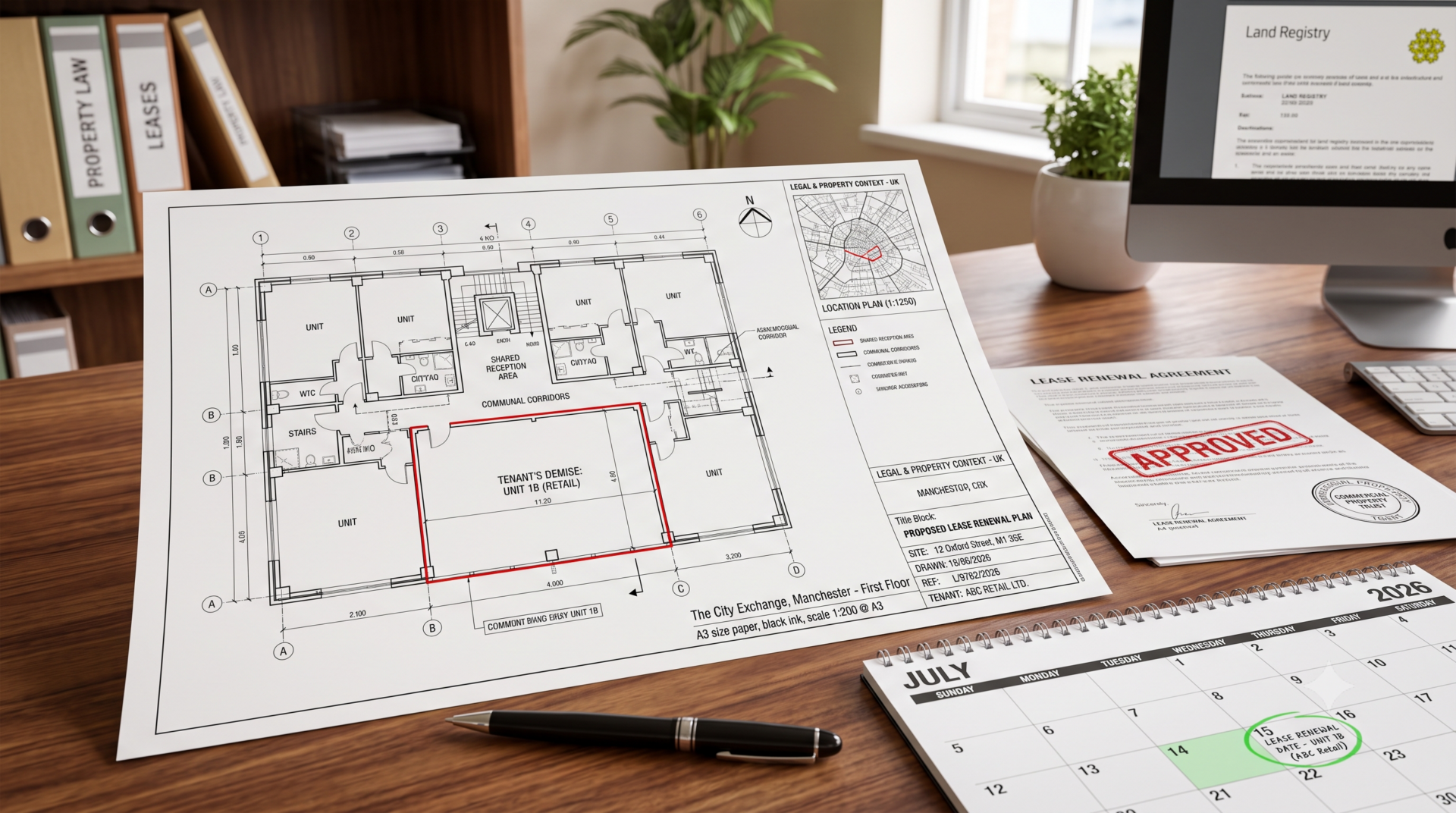
A commercial lease renewal plan is a scaled technical drawing prepared for a renewed commercial lease, and whether you need one depends on your existing plan’s compliance with HM Land Registry requirements and whether the demised premises have changed. When your commercial lease is approaching expiry, the question of whether you need a new plan often arises. The answer is not always straightforward, but getting it right is essential to avoid delays in registration and potential legal complications. In this guide, we explain when a fresh commercial lease renewal plan is required, when you can reuse existing drawings, and what steps to take to ensure a smooth renewal process.
When Is a Lease Plan Required for a Commercial Lease Renewal?
A lease plan is a scaled technical drawing that clearly shows the extent of a property over which a leaseholder has rights, and it forms part of the legal documentation submitted to HM Land Registry. For lease renewals, the requirement for a plan depends on several factors.
Registration Triggers a Plan Requirement
Leases granted for more than seven years must be registered with HM Land Registry. If your renewed commercial lease is granted for a term exceeding seven years including any new options or terms registration is mandatory. Registration requires a compliant lease plan.
If your renewed lease is for seven years or less, registration is not mandatory, though you may still choose to register for extra security, particularly if significant sums are invested in fit-out or goodwill.
The Land Registration Act 2002 Requirements
The Land Registration Act 2002 applies to leases granted after 13 October 2003, particularly long leases of seven years or more, which receive registered titles for enhanced protection. Upon registration, the lease receives its own registered title and obtains a higher level of protection.
For lease renewals, the responsibility for registration typically falls on the landlord, though this should be confirmed in the lease terms. Failure to register within the required timeframe usually two months can result in losing legal title to the lease.
Do You Need a New Plan or Can You Reuse the Existing One?
This is the central question for most tenants and landlords approaching a commercial lease renewal. The answer depends on several factors.
When You Can Reuse an Existing Plan
You may be able to reuse the existing lease plan if all of the following apply:
- The existing plan is fully HM Land Registry compliant (correct scale, north point, red edging, and sufficient detail)
- The demised premises have not changed since the original lease was granted
- The existing plan accurately shows the current layout and boundaries
- The plan is still clear and legible when reproduced
If the original lease plan was accepted by HM Land Registry at registration, it may be suitable for reuse, provided the property remains unchanged.
When You Need a New Commercial Lease Renewal Plan
A fresh commercial lease renewal plan is typically required in the following circumstances:
| Circumstance | Why a New Plan Is Needed |
| The original plan is missing | No plan exists to submit with the renewal application |
| The original plan is non-compliant | The plan fails to meet HM Land Registry standards (incorrect scale, missing north point, poor quality) |
| The property has been altered | Layout changes, extensions, or internal reconfiguration mean the old plan no longer reflects the premises |
| The freeholder or Land Registry requests one | HM Land Registry may raise a requisition requiring an updated plan |
| The lease is being varied | Changes to the demised area or rights require an updated plan |
Even where a plan exists, a fresh measured plan removes ambiguity and can prevent requisitions.
The Risk of Reusing a Non-Compliant Plan
HM Land Registry will raise a requisition — a formal request for corrections if a plan fails to meet the required standards. This pauses the application until a corrected or replacement plan is submitted, adding weeks to the transaction and generating additional costs. Given the timeframes involved in commercial lease renewals, this can be particularly disruptive.
What Makes a Commercial Lease Renewal Plan Compliant?
Whether you are reusing an existing plan or commissioning a new one, the commercial lease renewal plan must meet HM Land Registry requirements set out in Practice Guide 40 and its supplements.
Core Requirements
A compliant plan must meet the following core standards:
| Requirement | Description |
| Based on Ordnance Survey mapping | The plan must show sufficient OS detail for HM Land Registry to identify the land on the national map |
| Drawn to a stated metric scale | Typically 1:100 or 1:200 for floor plans and 1:1250 for location plans, with the scale clearly stated |
| North point included | A north arrow must appear on the plan to confirm orientation |
| Clear boundary edging | The demised area must be edged in red with a continuous line forming a complete enclosure |
| Sufficient surrounding detail | Enough context for the property to be identified unambiguously |
| Consistency with the lease wording | The plan must match the written description in the lease |
Additional Requirements for Lease Plans
Lease plans have additional requirements beyond the core standards:
- Relationship to the building footprint: The plan must show where the demised premises sit in relation to the external footprint of the building
- Floor-level plans: If the lease covers property on more than one floor, separate plans must be provided for each level
- Communal areas: Shared spaces such as hallways, stairwells, lifts, and bin stores must be shown and distinguished from the demised premises
- Access routes: The routes by which the tenant accesses the demised premises should be identifiable
Prohibited Content
Plans must not include disclaimers such as “For Identification Only”. HM Land Registry requires certainty, and such wording suggests the plan is not definitive.
The Commercial Lease Renewal Process and Plans
Understanding the commercial lease renewal process helps you determine when a plan is needed and how to time its preparation.
Reviewing Your Existing Lease
The first step is to review the terms of your existing lease. It is important to check the expiry date, any break clauses, and whether your lease is protected by the Landlord and Tenant Act 1954. These details determine your renewal rights and the procedure you must follow.
A central issue for many businesses is whether the lease is “inside” or “outside” the 1954 Act:
- Inside the Act (open lease): The tenant has security of tenure and a legal right to apply for a new lease. The landlord can only oppose renewal on limited statutory grounds.
- Outside the Act (closed lease): The tenant has agreed to contract out of the Act. There is no automatic right to renew, and the landlord may require the tenant to leave or offer a new lease on entirely new terms.
Statutory Notices and Timeframes
Where a lease is inside the Landlord and Tenant Act 1954, the renewal process is governed by formal statutory notices:
| Notice Type | Served By | Purpose |
| Section 25 notice | Landlord | Can propose terms for a new lease or state intention to oppose renewal |
| Section 26 notice | Tenant | Requests the grant of a new lease, usually setting out proposed terms |
Both notices are subject to strict legal requirements and must be served within specific timeframes, typically between six and twelve months before the lease expiry date. Errors in timing or form can have serious consequences.
When to Commission Your Plan
Given the statutory timeframes, it is advisable to commission your commercial lease renewal plan early in the process. If a site visit is required, this needs to be arranged around access and availability. Having a compliant plan ready when needed avoids hold-ups at the registration stage.
If you are unsure whether you need a new plan or can reuse the existing one, contact our team for professional advice. We can review your existing plan and advise on the most appropriate approach.
Deed of Variation vs New Plan
Sometimes, a lease renewal involves changes to the demolished premises rather than a straightforward renewal. In these cases, a deed of variation may be required.
A deed of variation is a legal document used to alter the plan attached to a lease, often to ensure compliance with HM Land Registry requirements. This standard document is designed to insert a new plan or substitute an existing one.
Important Considerations
If a deed of variation is used to extend the property’s demise or substitute property, it could operate as a surrender and regrant of the lease by operation of law. This may have significant and unintended consequences for both the landlord and tenant. Professional legal advice is essential before using a deed of variation in this context.
When a Deed of Variation Is Appropriate
A deed of variation is typically appropriate when:
- The lease plan needs minor corrections to meet Land Registry requirements
- The layout has changed but the extent of the demise remains substantially the same
- Both parties agree to the variation and the necessary consents are obtained
For more significant changes, such as extending the demised area, a new lease may be more appropriate.
View our portfolio to see examples of lease plans we have prepared for commercial lease renewals and deeds of variation.
Costs and Timescales for a Commercial Lease Renewal Plan
| Service Type | Typical Price (ex VAT) | Turnaround |
| Review of existing plan for reuse suitability | From £99 | 1-2 working days |
| Commercial lease renewal plan (from existing drawings) | From £299 | 3-5 working days |
| Commercial lease renewal plan (with site visit) | From £399 | 5-7 working days |
| Deed of variation plan | From £399 | 3-5 working days |
These prices typically include assessment, drafting, Ordnance Survey base mapping, and delivery as a PDF. Additional charges may apply for rush orders or complex properties.
Key Issues to Consider During Lease Renewal
Beyond the plan itself, several issues arise during commercial lease renewal that may affect your plan requirements:
Rent and Lease Length
Rent is often the central issue and is typically assessed by reference to current market conditions rather than the existing rent. The agreed term of the new lease affects whether registration is required and therefore whether a plan is needed.
Repair and Maintenance Obligations
The allocation of repairing responsibilities, particularly for structural elements, can have significant long-term cost implications and should be clearly defined. If the physical state of the premises has changed, this may affect the plan.
Changes to the Premises
If the tenant has made alterations during the lease term, the landlord may require these to be reflected in the new lease plan. Similarly, if the landlord has made changes to common areas, these should be shown.
Service Charge Arrangements
In multi-tenant buildings, service charge apportionment must be clearly documented. An updated plan may be needed to reflect changes in shared areas or usage.
Frequently Asked Questions
Do I need a commercial lease renewal plan for my lease renewal?
You need a commercial lease renewal plan if your renewed lease is for more than seven years and must be registered with HM Land Registry. Even if your lease is for seven years or less, you may need a new plan if the original plan is missing, non-compliant, or the premises have changed since the original lease. Contact our team for advice on your specific situation.
Can I reuse the existing lease plan when renewing my commercial lease?
You can reuse the existing lease plan if it is fully HM Land Registry compliant, the demised premises have not changed, and the plan remains clear and legible. However, if the original plan is missing, non-compliant, or the property has been altered, you will need a new commercial lease renewal plan.
What happens if my lease plan is rejected by HM Land Registry?
If HM Land Registry rejects your plan, your registration application will be delayed. You will need to correct the deficiencies and resubmit, which can add weeks to your transaction. The most common reasons for rejection are incorrect scaling, missing north point, and poor image quality.
How much does a commercial lease renewal plan cost?
Reviewing an existing plan for reuse suitability typically starts from £99 + VAT. A new commercial lease renewal plan from existing drawings starts from £299 + VAT, while a plan requiring a site visit starts from £399 + VAT. Prices include drafting, Ordnance Survey base mapping, and PDF delivery.
Do I need a site visit for a commercial lease renewal plan?
Not always. A site visit is usually only needed where there are no suitable existing drawings, where the property layout needs checking, where areas are unclear, or where measurements must be taken to prepare a reliable plan. If the existing lease plan is available but non-compliant, a plan may often be prepared remotely.
What is a deed of variation and when is it used for lease renewal?
A deed of variation is a legal document used to alter the plan attached to a lease, often to ensure compliance with HM Land Registry requirements. It is typically used when the layout has changed but the extent of the demise remains substantially the same. However, if used to extend the property’s demise, it could operate as a surrender and regrant of the lease.
When should I commission a commercial lease renewal plan?
You should commission your plan early in the renewal process, ideally before statutory notices are served. Having a compliant plan ready when needed avoids hold-ups at the registration stage. If a site visit is required, this needs to be arranged around access and availability, which can take time.
Next Steps
To determine whether you need a new commercial lease renewal plan or can reuse your existing plan, start by reviewing your current lease plan against HM Land Registry requirements. If you are unsure, contact our team to arrange a review. We can assess your existing plan, advise on compliance, and prepare a new commercial lease renewal plan if required.
Visit our services page to learn more about our lease plan services, or view our portfolio to see examples of our work. For more information about our surveying expertise, learn more about our company.

