
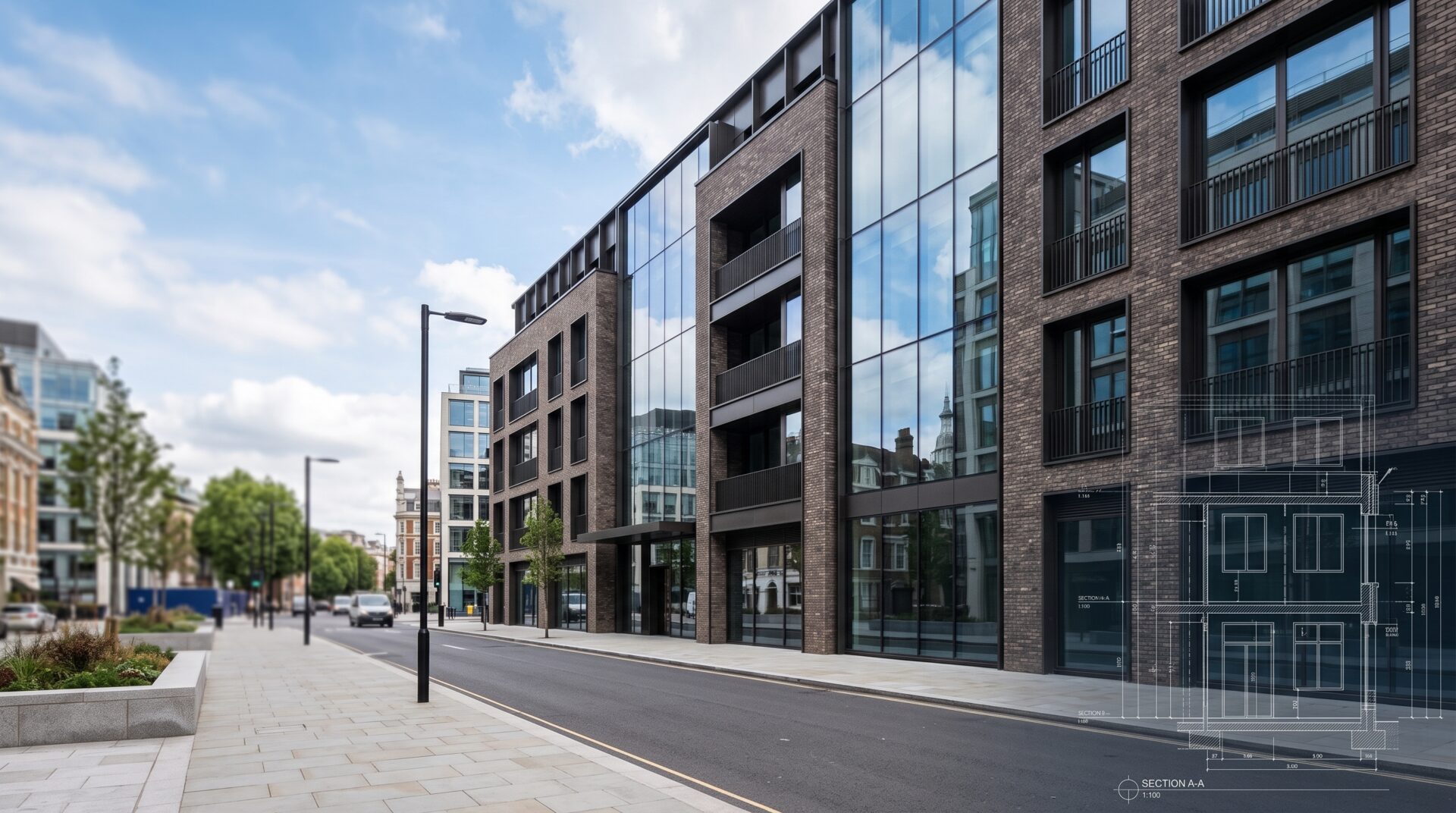
If you’ve searched “commercial property valuation near me,” you’re probably not looking for a definition you already know you need one, and you want to understand what’s actually involved before you pick up the phone. Maybe you’re a landlord heading into a rent review, a developer weighing up whether to extend or sell, or an architect trying to work out what a valuation means for a client’s redevelopment plans.
This guide walks through how commercial valuations actually work in London, what they cost, how long they take, and because that’s where we come in how a valuation connects to planning and design decisions that can genuinely change what a property is worth.
Table of Contents
ToggleWhat Is a Commercial Property Valuation?
A commercial property valuation is a formal assessment of a property’s current market or rental value, carried out by an RICS Registered Valuer and set out in a written report. It’s used for lending, tax, legal, and investment purposes, and is governed by RICS professional standards.
That’s different from a market appraisal you might get from a commercial agent trying to win your instruction. An agent’s figure is useful for gauging buyer or tenant interest, but it isn’t independent, isn’t governed by professional standards, and won’t be accepted by a lender, HMRC, or a court.
A commercial valuation surveyor working to RICS standards, by contrast, produces a report that can withstand scrutiny from a bank, a tribunal, or the other side in a rent review negotiation.
Why Businesses and Property Owners Need a Valuation
Common reasons to commission one:
- Refinancing or applying for commercial mortgage lending
- Lease renewals, rent reviews, and lease extension negotiations
- Buying or selling an investment property
- Portfolio valuations for reporting or accounting purposes
- Insurance reinstatement cost assessments
- Business rates checks and appeals
- Capital Gains Tax or Inheritance Tax planning on commercial assets
- Development or redevelopment appraisals before committing capital
One trigger worth flagging now: the next business rates revaluation in England and Wales takes effect on 1 April 2026, based on rental values as of 1 April 2024.<sup>[1]</sup> If your rateable value is about to shift, a current valuation gives you the evidence to check whether your new bill reflects your property’s actual position and to challenge it if it doesn’t.
How Commercial Property Valuation Works: The Methods Explained
Most valuation guides skip past this, but knowing which method your surveyor is using helps you interpret the report you get back and it’s genuinely useful if you’re an architect or developer trying to model how a design change might move the number.
The Investment (Income Capitalisation) Method
Used for let commercial property offices, retail units, industrial sheds with tenants in place. The surveyor takes the annual rental income and capitalises it at a market-derived yield.
Illustrative example only: an office generating £120,000 a year in rent, capitalised at a 7% yield, would work out at roughly £1.71 million (£120,000 ÷ 0.07). The yield itself is drawn from recent comparable transactions in the same sector and location, and varies significantly by asset type and area this figure is for illustration, not a market benchmark.
The Comparable Method
Used where there’s enough recent transactional evidence sales or lettings of similar properties nearby. The surveyor adjusts for differences in size, condition, location, and lease terms to arrive at a figure.
This is the most straightforward method conceptually, but it depends heavily on how much genuinely comparable evidence exists. In a thin market a specialist industrial unit, for example comparables can be hard to find.
The Residual Method
Used for development sites or properties with redevelopment potential. The surveyor works backwards from the estimated value of the finished scheme, deducting build costs, professional fees, finance costs, and developer’s profit to arrive at what the land or existing building is worth today.
This is where architectural input starts to matter directly; the residual value is only as good as the assumptions behind the “finished scheme,” which is exactly what a feasibility study or planning assessment helps define.
Depreciated Replacement Cost (DRC)
Used for specialist properties with few or no market comparables schools, hospitals, factories built for a specific process. The valuer estimates what it would cost to rebuild the property today, then deducts depreciation for age and condition.
What Happens During a Commercial Property Valuation
Site Inspection vs. Desktop Valuation
For a first-time instruction, expect a physical site visit. The surveyor needs to assess construction, condition, layout, and anything that might affect value a leaking roof, an unauthorised extension, poor accessibility.
For repeat instructions on the same property (a periodic revaluation for loan covenant purposes, for example), a desktop update is sometimes acceptable, provided nothing structural has changed since the last inspection. This is more cost-effective, but relies on the owner flagging any material changes honestly.
What to Prepare Before the Visit
Having the right documents ready speeds things up and tends to produce a more accurate report:
- Current lease documents and any side letters
- Floor plans and a measured survey, if you have one
- Service charge accounts (for multi-let buildings)
- Planning history and any existing permissions
- EPC certificate
- Recent schedule of condition, if one exists
How Long Does It Take?
Turnaround time depends on property complexity and how quickly site access can be arranged. As an unverified general guide, a straightforward single-let commercial property is often turned around within one to two weeks of instruction; multi-let or development sites typically take longer.
What Does a Commercial Property Valuation Cost in London?
Most valuation firms quote case-by-case rather than publishing a fixed price list, because the cost genuinely depends on several variables. If you’re comparing quotes for a commercial property valuation near me, expect the fee to move with:
| Factor | Effect on Fee |
| Property type (single office vs. multi-let retail parade) | More tenancies = more analysis = higher fee |
| Size and complexity | Larger, more complex buildings take longer to inspect and report on |
| Purpose of valuation | Red Book valuations for lending/tax typically cost more than a simple market opinion |
| Access and location | Harder access or properties requiring specialist input (plant, machinery) add time |
| Urgency | Expedited turnaround can carry a premium |
Ask for a fixed quote once you’ve described the property and purpose most reputable firms will confirm one before starting work.
RICS Red Book Standards: What You Should Know
A “Red Book” valuation means one carried out under RICS Valuation – Global Standards, the mandatory framework governing how RICS members conduct and report valuations designed to ensure consistency, objectivity, and transparency, which is why lenders and courts insist on it.
RICS introduced a new edition of the Global Standards, effective 31 January 2025, aligned with the updated 2025 International Valuation Standards.<sup>[2]</sup> It’s reasonable to ask your surveyor whether they’re working to this current edition.
How a Commercial Valuation Connects to Planning, Design, and Redevelopment
This is the part that tends to get skipped entirely on most valuation firms’ websites, because it sits outside what a surveyor does but it’s often the most valuable next step.
A valuation tells you what a property is worth as it stands. It doesn’t tell you what it could be worth with a change of use, an extension, or a reconfigured layout. That’s where architectural and planning input comes in.
Example: a residual valuation on a tired 1980s office building might come back lower than the owner hoped but a feasibility study looking at conversion to residential under permitted development rights, or a rooftop extension, could reveal upside the valuation alone wouldn’t capture. The surveyor values what’s there; a drafting and planning assessment explores what’s possible.
If you’re a builder, contractor, or developer working from a valuation report, treat the figure as a starting point for a conversation about design potential, not the final word on what the site is worth.
If you’ve had a valuation come back lower than expected, request a feasibility study to see what redevelopment or change-of-use options might unlock before you decide to sell.
Commercial Property Valuation and Lease Events
A significant share of commercial valuations happen because of something in the lease calendar, not a sale or purchase.
Rent reviews typically require an independent valuation to establish current market rent, especially where landlord and tenant can’t agree informally. Lease renewals under the Landlord and Tenant Act 1954<sup>[3]</sup> often turn on valuation evidence when terms are contested. Lease extensions particularly for long leasehold commercial interests depend on a valuation to calculate the premium payable.
If you’re navigating any of these, our lease renewal and rent review support can help you get a valuation in place early rather than reactively which gives you a stronger negotiating position, because you’re working from evidence rather than guesswork.
How to Choose a Commercial Valuation Surveyor Near You in London
A few checks will save you problems later:
- RICS Registered Valuer status not just RICS membership, but specifically registered under the Valuer Registration Scheme
- Sector experience a surveyor who mainly values retail units may not be the right fit for an industrial estate or a specialist healthcare building
- Local market knowledge someone who actively transacts in your part of London will have better comparable evidence than a firm operating remotely
- Professional indemnity insurance confirm it’s current, particularly for lending-related instructions
- Clear scope and fee before instruction a good surveyor confirms purpose, basis of value, and fee in writing before starting
Frequently Asked Questions
What’s the difference between a commercial property valuation and a market appraisal? A market appraisal is an informal opinion, often from an agent, intended to help price a property for sale or letting. A formal valuation is produced by an RICS Registered Valuer under Red Book standards and is suitable for lending, tax, and legal purposes.
How often should a commercial property be revalued? It depends on the purpose loan covenants often require annual or biennial revaluation, while owners without a specific trigger might revalue every few years or whenever a significant change occurs (a new lease, refurbishment, or market shift).
Does a commercial valuation affect my business rates? Not directly business rates are set by the Valuation Office Agency through a separate revaluation process. But your own valuation can help you assess whether a new rateable value looks accurate and worth challenging.
Can a valuation be done without a physical site visit? Sometimes, for a desktop update on a property the surveyor has already inspected but a first-time valuation typically requires an in-person inspection.
Who typically requests a commercial valuation from a landlord or tenant? Either party can, depending on the trigger. Landlords often commission valuations for rent reviews or refinancing; tenants may commission one to challenge a proposed rent or assess a lease extension premium.
How does a valuation affect refinancing or a mortgage application? Lenders require a current Red Book valuation to confirm the property provides adequate security for the loan amount before releasing funds.
Thinking Past the Valuation Number
A valuation report tells you where a property stands today. If you’re an architect, developer, or contractor, the more useful question is usually what happens next whether that’s a change of use, an extension, or a full redevelopment appraisal.
Get in touch to talk through a feasibility assessment for your property, or explore our planning and design services to see how we work alongside valuations to plan what’s possible.

