
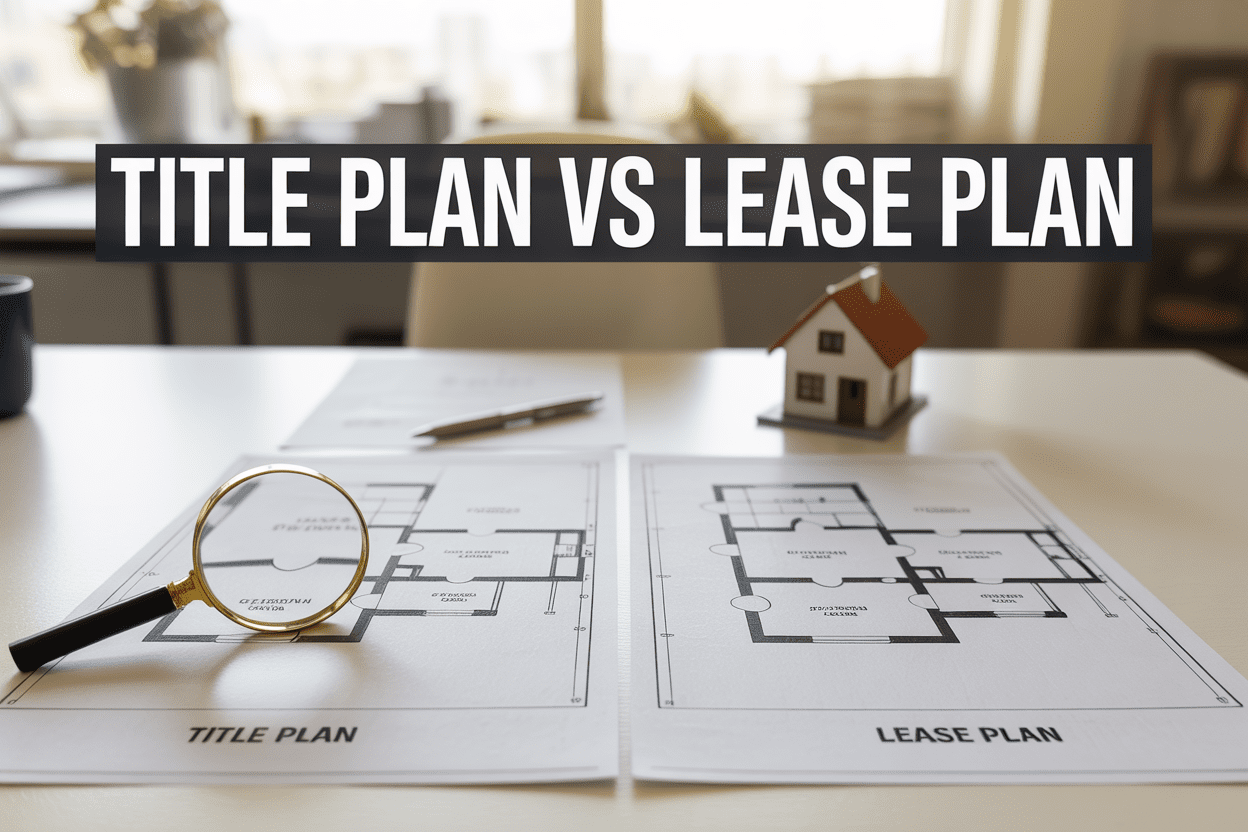
Title plan vs Lease plan
If you’ve been staring at property documents trying to figure out the difference between a title plan and a lease plan, you’re not alone. These two plans get mixed up all the time — and submitting the wrong one can mean rejected applications, delays, and extra costs you really don’t need.
In this post, we’re walking you through exactly what sets them apart. We’ll cover what each plan actually does, when you need one (or both), and the most common mistakes people make when submitting them to HM Land Registry. Whether you’re a property owner, tenant, solicitor, or landlord dealing with a new lease, this guide is for you.
Understanding Title Plans: What They Are and Why They Matter

Definition and Core Purpose of a Title Plan
A title plan is a scaled map prepared by HM Land Registry when a property is registered. It uses an extract from the Ordnance Survey (OS) map to give a visual indication of the registered land, with the boundary edged in red something we refer to as “the extent.” Its core purpose is to support the property description held in the title register, not to stand alone as a legal document. Together, the register and the title plan form the official legal record of a property.
Key Features That Make a Title Plan Unique
What sets a title plan apart is its reliance on Ordnance Survey mapping and its use of colour-coded references to communicate complex legal information at a glance. Here are the key features we see on every title plan:
- Unique title number — identifies the specific registered property
- Red edging — outlines the extent of the registered land
- North arrow and OS map reference — provides geographic orientation
- Black lines — represent physical features such as walls, fences, buildings, and hedges
- Date and time stamp — confirms when the copy was taken
- Colour references — such as blue or pink tinting, used to highlight areas affected by restrictive covenants, easements, or boundary agreements explained in the register
It is important to note what a title plan does not show:
| What It Shows | What It Does Not Show |
|---|---|
| General boundaries of the land | Exact legal boundary positions |
| Physical features (walls, fences) | Ownership of boundary features |
| Colour-coded legal references | Mortgages or charges |
| Shared access routes | Precise measurements |
We must always read the title plan alongside the title register to get the full picture, as the plan alone carries only supporting — not full legal — authority.
When You Need a Title Plan
When comparing a title plan vs lease plan, it helps to first understand the situations where a title plan is specifically required. We typically need a title plan when:
- Selling a property — buyers and their solicitors need to verify the land included in the title
- Transferring ownership — whether as a gift or legal transfer, the plan confirms what is being passed on
- Remortgaging — lenders require confirmation of the property’s registered extent
- Resolving boundary disputes — the title plan provides a starting reference point, even if further legal steps are needed
- Verifying land before purchase — buyers use it to confirm that the land on the ground matches what is registered
It is worth noting that a title plan is rarely useful on its own. Most legal and financial processes require it to be used together with the title register to carry any meaningful weight.
Understanding Lease Plans: What They Are and Why They Matter

Definition and Core Purpose of a Lease Plan
A lease plan is a detailed, scaled drawing that defines the specific area covered by a lease agreement. Unlike a general floor plan, it is a legal document submitted to HM Land Registry to formally register leasehold properties, making it essential for any lease exceeding seven years.
Key Features That Make a Lease Plan Unique
What sets a lease plan apart is its strict compliance requirements. It must include a north point, clearly defined boundaries (often shown through hatching or colour-coding), an Ordnance Survey location plan inset, and metric measurements drawn to an approved scale typically 1:100 or 1:200 for floor plans and 1:1250 for site plans. It goes beyond showing internal layouts by also identifying shared spaces, access routes, parking areas, and communal facilities, giving all parties a precise understanding of what the lease covers.
When You Need a Lease Plan
With this in mind, knowing when a lease plan is required helps us avoid costly delays. We need one whenever we are registering a lease of more than seven years with HM Land Registry. This applies to both landlords and tenants involved in leasehold transactions, including situations where shared spaces or access points must be formally documented. Without a compliant lease plan, the lease simply cannot be registered.
Title Plan vs Lease Plan: Breaking Down the Key Differences

A. Differences in Purpose and Legal Requirements
When comparing a title plan vs lease plan, the most fundamental distinction lies in their purpose. A title plan defines the general boundaries of a freehold or leasehold property as recorded by HM Land Registry, and it is required for all registered properties. A lease plan, on the other hand, specifically identifies the exact area being leased known as the demised premises — and is legally required for any lease of seven years or more. Submitting one in place of the other will result in a rejected application.
B. Differences in Level of Detail and Scale
Now that we have covered their purposes, let’s look at how they differ in detail and scale. Title plans are relatively basic, showing only the general boundary of a property outlined in red, based on Ordnance Survey mapping at a scale of 1:1250 (urban) or 1:2500 (rural). Lease plans, however, are far more detailed drawn typically at 1:100 for buildings, they must clearly show individual walls, rooms, access points, shared spaces, a north arrow, and accurate measurements.
C. Differences in Land Registry Compliance
With this in mind, we must also consider how each plan meets Land Registry compliance requirements. Title plans are based on existing Ordnance Survey data and are indicative only, meaning they do not always reflect exact legal boundaries. Lease plans must strictly adhere to Land Registry guidelines — they require precise scaling, a north point, an Ordnance Survey location plan inset, and clear colour-coding to distinguish leased areas from shared or excluded spaces.
| Feature | Title Plan | Lease Plan |
|---|---|---|
| Purpose | Defines general property boundaries | Shows the specific leased area |
| Required for | All registered properties | Leases over 7 years |
| Level of Detail | Basic (general boundary only) | High (walls, rooms, access rights) |
| Scale | 1:1250 (urban) / 1:2500 (rural) | Usually 1:100 for buildings |
| Land Registry Compliance | Based on Ordnance Survey mapping | Must meet strict Land Registry guidelines |
Can One Property Have Both a Title Plan and a Lease Plan

How Leasehold Flats Use Both Plans
Yes, a single property can absolutely have both a title plan and a lease plan, and leasehold flats are the most common example. When a developer builds a block of flats, the freehold of the entire building is registered with one title plan showing the full site boundary. Each individual flat is then leased out, and every one of those leases requires its own separate lease plan to define exactly which part of the building that leaseholder occupies — including any shared hallways, stairwells, or communal gardens. So, in a block of ten flats, we could have one freehold title plan covering the whole building and ten individual lease plans, one per flat. Both documents work together, with the title plan establishing overall ownership and each lease plan carving out the specific leasehold interest within it.
How Commercial Properties Use Both Plans
With this in mind, commercial properties operate in exactly the same way. Consider a multi-unit commercial development — a retail parade or an office building, for instance. The freeholder registers the entire site under one title plan. When individual units are leased to business tenants, each lease must be accompanied by a compliant lease plan showing precisely which unit, access routes, and shared areas are included in that particular lease. We often see this in shopping centres, industrial estates, and mixed-use developments, where one freehold title plan sits at the top and multiple lease plans sit beneath it, each defining a separate commercial leasehold interest within the same registered title.
Common Mistakes to Avoid When Submitting Title Plans and Lease Plans

Using a Title Plan Instead of a Lease Plan
One of the most frequent mistakes we see is submitting a Title Plan when a Lease Plan is actually required. When leasing part of a building — such as a flat or a commercial unit — the Title Plan simply won’t suffice, as it only outlines the registered title boundary of the whole property, not the specific demised area being leased.
Missing Shared Spaces in a Lease Plan
We often encounter Lease Plans that fail to identify shared or communal areas, such as stairwells, corridors, car parks, or access routes. If these spaces aren’t clearly marked, it creates ambiguity over rights and responsibilities, which can lead to disputes between landlords and tenants down the line.
Incorrect Boundaries on a Title Plan
Incorrect boundary lines are among the most legally significant errors we come across. A boundary that is too large, too small, or incorrectly positioned on a Title Plan can trigger ownership disputes with neighbours, stall property transactions, or even jeopardise equity release applications — as illustrated by cases where missing access paths caused major complications for homeowners.
Failing to Follow Land Registry Guidelines
When we submit plans that don’t meet HM Land Registry requirements — whether due to incorrect scale, missing measurements, or inadequate detail — applications are rejected outright. This causes costly delays. Always double-check that every plan meets current Land Registry standards before submission to avoid unnecessary setbacks.
How to Get a Land Registry-Compliant Plan

Choosing the Right Professional for the Job
Now that we have covered the key differences between a title plan and a lease plan, it is equally important that we ensure whoever prepares our plans is equipped to meet Land Registry standards. We should seek a professional who specialises in scale property plans, as a properly drawn plan — produced compliantly from the outset — saves considerable time, cost, and stress throughout the transaction process.
Key Requirements for Accurate and Compliant Plans
With this in mind, we must ensure every plan we submit meets the following Land Registry requirements:
- Drawn to a stated scale: We should use 1:1250 or 1:500 for urban properties and 1:2500 for rural land, always based on metric measurements.
- North point included: Our plan must clearly show its orientation.
- Sufficient surrounding detail: Roads, buildings, and nearby features must be visible so the property can be identified against the Ordnance Survey map.
- No draft markings: Phrases like “for identification purposes only” or “do not scale from this drawing” must never appear on our final submitted plan.
- Clear boundary edging: Boundaries must be continuous, with no gaps, completely encircling the property — traditionally edged in red.
- Floor level specified: For lease plans particularly, we must state which floor the plan depicts, using separate plans for multiple floors where necessary.

Understanding the difference between a Title Plan and a Lease Plan is essential for anyone navigating property transactions in the UK. A Title Plan defines the general boundaries of a freehold or leasehold property and is required for registrations, purchases, and sales. A Lease Plan, on the other hand, provides a detailed drawing of the specific area being leased and is mandatory for leases of seven years or more. In many cases, particularly with leasehold properties like flats or commercial units, both plans are needed — each serving its own distinct purpose.
Getting these plans right from the start can save us from costly delays, rejected applications, and potential legal disputes down the line. Whether we are buying, selling, or leasing a property, ensuring our plans are Land Registry-compliant, drawn to the correct scale, and prepared by a professional is the smartest step we can take. If we are ever unsure which plan is needed or how to get one prepared correctly, reaching out to a qualified surveyor or mapping expert is always the best course of action.

