
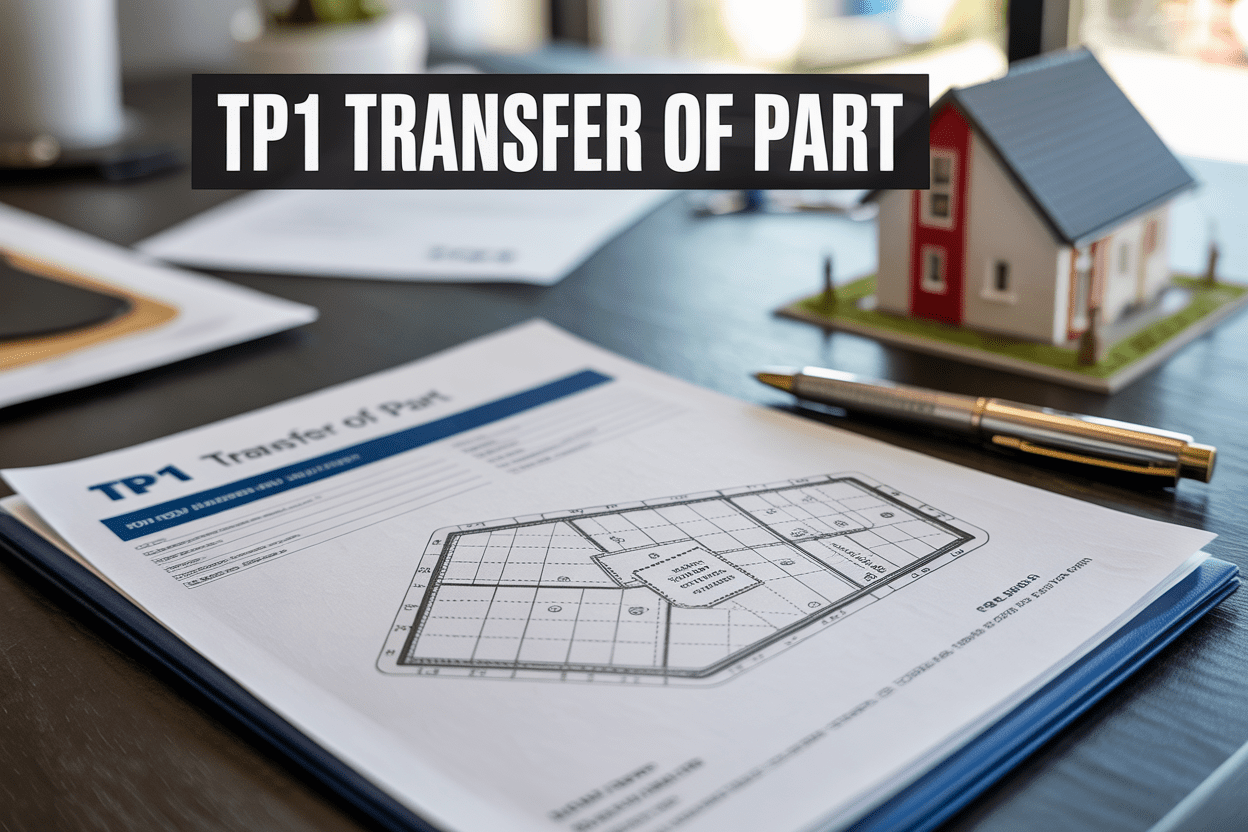
Transfer of Part Plan UK
Selling part of a registered title in the UK like splitting off a section of garden from a larger property means you’ll need to get to grips with form TP1 and its supporting plan requirements. Get these wrong, and HM Land Registry will reject your application, which costs time and money.
This guide is for property owners, buyers, solicitors, and conveyancers who need to understand exactly what a transfer of part plan UK submission involves and how to get it right first time.
We’ll walk you through three key areas: what the TP1 form actually is and when you need it, what makes a Land Registry-compliant plan, and which panels and additional documents you must include to avoid a rejection. Whether you’re looking at a transfer of part Land Registry example for the first time or checking your paperwork before submission, we’ve got you covered.
Understanding the TP1 Form and Its Purpose

What the TP1 Form Is Used For in Property Transactions
We use Form TP1 to transfer part of a registered title for example, where a house and garden are registered under one title and we want to sell part of the garden as a separate parcel of land.
Common Scenarios Requiring a Transfer of Part
When splitting a larger registered title, we typically encounter situations such as selling off a portion of land, dividing a plot for development, or separating outbuildings from a main property. Each of these scenarios requires a TP1 to formally transfer ownership of that specific part.
Difference Between Transfer of Whole and Transfer of Part
| Aspect | Transfer of Whole | Transfer of Part |
|---|---|---|
| Form Used | TR1 | TP1 |
| Title Affected | Entire registered title | A portion of a registered title |
| Plan Required | Generally simpler | Mandatory identifying plan attached |
Where a transfer of whole conveys the entire registered title to a new owner, a transfer of part deals only with a defined portion, meaning we must attach a plan to the TP1 precisely identifying the land being transferred.
Essential Plan Requirements for TP1 Submissions

Why an Accurate Plan Must Be Attached to Form TP1
When we submit a Transfer of Part plan UK application, attaching an accurate plan to Form TP1 is not optional it is a fundamental legal requirement. A verbal description alone is rarely sufficient to clearly identify the land being transferred, particularly where boundaries are complex or the extent of the title is ambiguous. HM Land Registry needs to be able to pinpoint the exact parcel of land on the Ordnance Survey (OS) map, and only a properly prepared, compliant plan can achieve this with the precision required.
Without an accurate plan, our TP1 application risks outright rejection, causing costly delays and requiring resubmission with a replacement plan. Given that transfer plans can cost upwards of £199 for smaller properties with prices rising for larger sites getting it right the first time saves us both time and money. If the land being transferred forms part of a larger registered title, the plan becomes even more critical, as it must clearly delineate exactly which portion is being separated from the existing title.
HM Land Registry Standards for Plans
To ensure our Transfer of Part plan UK meets HM Land Registry compliance standards, we must adhere to a specific set of criteria. Below is a summary of the key requirements:
| Requirement | Detail |
|---|---|
| Scale | 1:500 or 1:1250 for urban properties; 1:2500 for larger or rural sites |
| Orientation | A north point must be clearly shown |
| Map base | Must be based on Ordnance Survey mapping with sufficient surrounding detail |
| Measurements | Metric units only, to two decimal places |
| Boundaries | Clearly edged without obscuring underlying map detail |
| Bar scale | Must be included on the plan |
| Signature | Must be signed by the seller or their authorised representative |
| Electronic submission | Scanned at 200–600 dpi, no more than two A3 pages |
The plan must also show all buildings, garages, gardens, parking areas, access drives, and pathways in their correct positions. Where unusual extents are involved such as airspace, roofspace, tunnels, or advertising hoardings we must specify height or depth details, which can be defined using Ordnance Survey datum. These guidelines stem from the legal framework introduced in 2002, which standardised all plan submissions to HM Land Registry.
We must also ensure that the plan does not carry the phrase “for identification only,” as this is a known defect that can lead to rejection. Other common reasons for rejection include:
- Unclear or unstated scale
- Poorly defined or ambiguous boundaries
- Excessive line thickness that obscures map detail
- Plans that cannot be accurately related to the OS map
- Unsigned plans or plans not physically attached to the deed
How to Clearly Identify the Land Being Transferred
With this in mind, one of the most important aspects of a compliant Transfer of Part plan UK is ensuring that the land being transferred is unmistakably identifiable. We must edge or highlight the demise clearly on the plan, using a colour or line style that does not obscure the underlying OS map detail. The title number of the parent title must also be referenced on the plan.
Where the property involves shared or common areas such as communal access routes, parking spaces, bin stores, or rights of way these must be clearly distinguished from areas under the sole responsibility of the transferee. For flats or properties within larger buildings, floor levels must be clearly outlined where they are not aligned, such as in flying freehold situations or where a flat sits within a larger block.
It is also important to note that verbal descriptions referencing plot numbers or postal addresses are not acceptable unless the extent is already clearly defined on the existing title plan. The plan we submit must be based on the current approved estate plan where one exists, ensuring full consistency with HM Land Registry records.
Key Panels in the TP1 Form You Must Complete Correctly

Panels 5 and 6 Requirements for Registered Proprietors
Following the plan requirements we covered earlier, we must now turn our attention to correctly completing the individual panels within the TP1 form. Panels 5 and 6 were amended as a result of the Land Registration (Amendment) Rules 2022, and the side notes to these panels clarify that all persons assenting and being shown as registered proprietor must be included in the relevant panel. Panel 5 captures the transferor the full legal name of the person or entity transferring the part of the property while Panel 6 captures the transferee, meaning the full name of the person or organisation receiving the transferred land. Omitting any registered proprietor from either panel is a common error that can delay your HM Land Registry application, so we always recommend double-checking that every party is named precisely as they appear on the existing title register.
Panel 7 Email Address Requirements
With Panels 5 and 6 addressed, we can move on to Panel 7, which relates to the address for the transferee. It is worth noting that as of 29 August 2023, a side note to Panel 7 was amended to replace the previous reference to “electronic address” with “email address” for greater clarity. This update ensures that parties providing contact details understand exactly what information is required, reducing the risk of incomplete submissions when registering a transfer of part with HM Land Registry.
Panel 12 Guidance on Easements
Now that we have covered the party and contact details panels, we turn to Panel 12 Additional Provisions which is one of the most legally significant sections of the TP1 form. This is where covenants, easements, and any other agreements between the transferor and transferee are formally recorded. For anyone involved in a transfer of part in the UK, easements are particularly important because they define rights such as access over neighbouring land. HM Land Registry directs us to Practice Guide 62 on easements for detailed guidance, or alternatively recommends consulting a conveyancer. Getting Panel 12 right is critical, as incorrectly drafted easement provisions can create lasting legal disputes over property boundaries and rights of way.
Panel 13 Dating the Transfer on Completion Day
With the additional provisions recorded correctly, we must ensure Panel 13 the Execution panel is completed accurately. A side note added on 27 May 2016 clarifies that the transfer must be dated, and that date must be the day of completion itself. All transferors are required to legally sign the deed at this stage. A further side note added on 17 June 2019 directs parties to Practice Guide 8: Execution of Deeds to ensure signatures and witnessing are carried out in the correct legal manner, avoiding any issues that could invalidate the transfer of part document.
Additional Documents Required Alongside Form TP1

Why Form AP1 or Form FR1 Must Accompany Every TP1
Now that we have covered the key panels in the TP1 form, we must address the additional documents required to complete a successful Transfer of Part submission to HM Land Registry. Every TP1 form must always be accompanied by either a Form AP1 (application to change the register) or a Form FR1 (application for first registration). Without one of these forms, our submission will be incomplete and rejected. These accompanying forms serve as the official application mechanism that instructs HM Land Registry to process the changes to the registered title, meaning the TP1 alone is never sufficient on its own.
How to Handle Mortgages With Form DS3
If there is a mortgage affecting the land being transferred, we may need to contact the lender and obtain a discharge of part, known as Form DS3. This step is critical because a mortgage registered against the title could otherwise affect the land being separated out in the Transfer of Part. We should refer to Practice Guide 31 for detailed guidance on how DS3 interacts with our TP1 submission, or seek advice from a conveyancer to ensure the lender’s requirements are correctly satisfied before we proceed.
Identity Requirements You Need to Satisfy
With this in mind, we must also consider HM Land Registry’s identity requirements as part of our Transfer of Part submission. Land Registry sets specific identity verification obligations that all parties involved in the transaction must satisfy. Failing to meet these requirements can delay or prevent registration. We recommend reviewing Land Registry’s current identity verification guidelines carefully to ensure our submission is fully compliant and processed without unnecessary delays.
Executing and Submitting the TP1 Form Successfully

Proper Execution of Deeds Under Practice Guide 8
Once we have completed all the required panels, the TP1 must be executed correctly as a deed. All transferors are legally required to sign Panel 13, and the deed must be witnessed to become valid and binding under UK property law.
Fees and Submission Address for Completed Forms
With this in mind, once signed and witnessed, we submit the completed TP1 form to HM Land Registry along with the applicable registration fee. The Land Registry then processes the application and updates the property title to reflect the transfer of part, typically within two to six weeks.
How to Request Accessible Formats for Assistive Technology Users
Previously, we’ve ensured all documentation meets submission standards. HM Land Registry also accommodates assistive technology users who require accessible formats of forms, including the TP1. We can contact HM Land Registry directly to request alternative formats suited to specific accessibility needs, ensuring all parties can fully participate in the transfer of part process.
Recent Updates to the TP1 Form That Affect Your Submission

2023 Amendment Replacing Electronic Address With Email Address
On 29 August 2023, HM Land Registry updated the TP1 form’s side note to panel 7, replacing the reference to “electronic address” with “email address” for greater clarity. We recommend reviewing this panel carefully to ensure our submissions align with the current terminology used in the Transfer of Part Land Registry requirements.
2022 Changes to Panels 5 and 6 Under Land Registration Amendment Rules
On 1 August 2022, panels 5 and 6 of the TP1 form were amended as a direct result of the Land Registration (Amendment) Rules 2022. These changes affect how we present transferor and transferee information, so we must ensure our Transfer of Part plan UK submissions reflect these updated panel requirements precisely.
Earlier Updates That Clarified Dating and Execution Requirements
Earlier updates also shaped how we complete the TP1 form today. In May 2016, side notes were added to panels 4 and 13, clarifying that the transfer must be dated on the day of completion. In June 2019, a side note was added to the execution panel directing us to practice guide 8 on execution of deeds. Additionally, the May 2015 update clarified that all persons assenting and shown as registered proprietors must appear in panels 5 and 6 a requirement that remains critical to a successful Transfer of Part Land Registry submission.

Successfully completing a Transfer of Part using Form TP1 requires careful attention to multiple interconnected requirements. We have covered the essential elements, from understanding the form’s purpose and preparing a compliant plan, to completing the key panels correctly, gathering the necessary supporting documents, and staying up to date with the latest amendments. Each of these steps plays a vital role in ensuring our submission meets HM Land Registry’s standards and avoids unnecessary delays.
When submitting Form TP1, we must always remember to accompany it with either Form AP1 or Form FR1, attach a clearly defined plan identifying the land being transferred, and account for any mortgage-related requirements such as obtaining a Form DS3 where needed. If we encounter complex areas such as Panel 12 relating to easements, consulting a qualified conveyancer is strongly recommended. By approaching the process thoroughly and methodically, we give our Transfer of Part the best possible chance of a smooth and successful registration.

