

We know property ownership can feel overwhelming, especially when dealing with official documents from the Land Registry. If you’re a homeowner, solicitor, or conveyancer trying to understand what a red line plan Land Registry document actually shows, you’re in the right place.
A red line plan is the visual map that comes with your property registration, showing the boundaries and extent of your registered land with distinctive red edging. These plans help identify exactly what land belongs to your title and often include important references for rights of way, covenants, and other legal matters that affect your property.
In this guide, we’ll walk you through the different types of title plans you might encounter, from modern vector plans to older paper versions. We’ll explain how to read the color coding and symbols that appear on your plan, including what those red lines actually mean for your property boundaries. You’ll also learn about the technical specifications like scale and size, plus special considerations that apply to leasehold properties where the red edging might show just the building outline rather than individual apartments.
 Understanding red line plans and title plans is essential for anyone dealing with property transactions, boundary disputes, or land registration matters. We’ve explored how these documents work as visual representations of your property’s extent, the importance of reading them alongside the property register, and the various color-coding systems that identify easements, covenants, and boundary features. Remember that the red edging shows general boundaries rather than exact legal boundaries, and the scale limitations of Ordnance Survey mapping mean these plans serve as guides rather than precise measurements.
Whether you’re a property owner, solicitor, or conveyancer, we recommend always obtaining official copies from HM Land Registry and consulting the accompanying register for complete understanding. If you encounter boundary disputes or need precise boundary determination, seeking professional legal advice remains the best course of action. By mastering how to read and interpret these crucial documents, you’ll be better equipped to navigate property matters with confidence and avoid potential complications in your land dealings.
Understanding red line plans and title plans is essential for anyone dealing with property transactions, boundary disputes, or land registration matters. We’ve explored how these documents work as visual representations of your property’s extent, the importance of reading them alongside the property register, and the various color-coding systems that identify easements, covenants, and boundary features. Remember that the red edging shows general boundaries rather than exact legal boundaries, and the scale limitations of Ordnance Survey mapping mean these plans serve as guides rather than precise measurements.
Whether you’re a property owner, solicitor, or conveyancer, we recommend always obtaining official copies from HM Land Registry and consulting the accompanying register for complete understanding. If you encounter boundary disputes or need precise boundary determination, seeking professional legal advice remains the best course of action. By mastering how to read and interpret these crucial documents, you’ll be better equipped to navigate property matters with confidence and avoid potential complications in your land dealings.
Understanding Title Plans and Their Purpose

What a title plan is and how it works with the property register
A title plan serves as a crucial visual component that supports the property description in the register by providing a graphic representation of the land boundaries. We understand that when HM Land Registry registers a property, they prepare both a register and a title plan that work together as complementary documents.The three essential elements of a registered title
We recognize that a registered title consists of three fundamental elements: the register itself, the title plan, and any documents referred to in the register and filed at HM Land Registry. The title plan must always be viewed in conjunction with the register, as it provides a plan of the information contained within the register rather than standing as an independent document.How title plans provide graphic representation of land boundaries
We know that title plans identify the general extent of land in a registered title through red edging that follows the inside of physical boundary lines. Based on Ordnance Survey mapping, these plans enable us to create standardized representations and relate individual title plans to one another, though adjoining plans may be based on different Ordnance Survey versions showing varying site details.Types of Title Plans You’ll Encounter

Vector title plans – modern computer-generated plans
Vector title plans represent the most modern approach to Land Registry documentation. We see these electronically created and stored plans produced by HM Land Registry’s computer mapping system, with all newly created title plans now utilizing this technology. What makes vector plans particularly valuable is their “intelligent” nature – they’re digitally generated with enhanced functionality that allows for easier updating and manipulation compared to older formats.Raster title plans – scanned images of former paper plans
Raster title plans serve as digital archives of historical documentation. We encounter these as electronically stored images of what were originally paper title plans from earlier registration periods. While all paper title plans have been scanned and converted to raster format, they differ significantly from vector plans in that they lack “intelligent” functionality – they’re essentially digital photographs of the original documents rather than interactive mapping data.Drawer/canister title plans – large paper plans stored physically
Drawer/canister title plans represent the most traditional format still in existence. We find these exclusively in paper form because their large size made them impossible to scan during the digitization process. These plans are carefully preserved either filed flat in specialized drawers or held in protective metal canisters, and they invariably belong to older registered titles with extensive land areas that required larger-scale documentation than standard paper sizes could accommodate.How to Read the Red Edging and Color Coding

Understanding what red edging means for your property boundaries
Red edging on our title plans shows the extent of registered land and represents the general boundaries of what we own. We use red lines that follow the inside of boundary features like walls, hedges, and fences shown on the Ordnance Survey map. However, we cannot treat this red edging as identifying the exact position of legal boundaries, as the law relating to boundaries is complex and our plans are limited by the scale and accuracy of the underlying OS mapping.Interpreting green edging for excluded or transferred land
When land has been removed from our title, such as when part of a garden has been sold off, we usually show this by green edging on the title plan. We may also display the new title number for the removed area in green. Green tinting or hatching with red edging around it indicates an ‘island’ of land excluded from our title, with explanatory notes added to both the property register and title plan.Decoding color references for easements and covenants
We use various color references, tinting, and symbols on our title plans to identify areas affected by easements, restrictive covenants, and boundary agreements. These colored references correspond to specific entries in our register – for example, blue tinting might indicate land subject to restrictive covenants, while pink tinting could show areas affected by particular conveyance conditions. We must always read our title plan alongside the register to understand what each color reference means for our property rights.Scale, Size and Technical Specifications

Standard scales used in urban versus rural areas
We find that Land Registry title plans follow specific scale conventions based on location density. In urban areas, title plans are typically prepared at a scale of 1:1250, while rural areas use 1:2500. For exceptionally large rural properties, we may encounter scales of 1:5000 or 1:10,000. These different scales ensure that property boundaries and features remain clearly visible regardless of the property size and surrounding development density.Paper sizes and how they affect plan presentation
We observe that title plan sizes vary significantly depending on when they were created and the property extent. Historically, most paper title plans were prepared on B4 paper, with larger properties requiring additional pages or flaps. Contemporary vector title plans offer more flexibility, ranging from A4 for smaller properties up to A0 for extensive areas, though A3 remains the standard size. When detail needs clarification, we may find enlargements added to show specific areas more clearly.Why dimensions on older plans may be unreliable
We must exercise caution when interpreting dimensions on older title plans, as these measurements were often taken directly from historical deeds at registration time. While these dimensions may provide additional boundary indication, they don’t override the general boundary rule that governs all title plans. Land Registry no longer routinely reproduces dimensions from deed plans on new registrations, and imperial measurements from pre-1995 plans haven’t undergone systematic conversion to metric units.Boundary Information and Limitations

General boundaries versus determined boundaries explained
We encounter two main types of boundaries in Land Registry title plans. General boundaries, which apply to the vast majority of registered titles under section 60(1) of the Land Registration Act 2002, show only an approximate position without detailed enquiries into precise locations. These boundaries have no standard tolerance or measurement ratio between the mapped position and the actual legal boundary. In contrast, determined boundaries provide exact identification of boundary positions through a specific application process that almost invariably requires agreement from adjoining owners.Why you cannot rely on title plans for exact boundary positions
We must understand that title plans cannot provide exact boundary positions due to inherent limitations in Ordnance Survey mapping and survey tolerances. Even the most detailed surveys using modern instruments operate within defined tolerances, and large-scale Ordnance Survey mapping is no exception. The red line on our title plans reflects what we conclude to be a reasonable interpretation of pre-registration deeds in relation to Ordnance Survey detail, but there’s no limit to the quantity of land that can fall within the scope of general boundaries rule, as established in Drake v Fripp [2011].How physical features relate to legal boundaries
We distinguish between legal boundaries – invisible lines with no thickness dividing properties – and physical boundaries such as fences, walls, or hedges that we can actually see. While physical features may coincidentally follow legal boundary lines, the legal boundary might run within the physical structure, along one side, or include parts of adjoining roadways or streams. Living boundary structures like hedges can move over time, making their original positions difficult to discern, and case law establishes that boundary position depends on pre-registration conveyance terms as a whole, with courts referring to physical features on the ground when plans are insufficiently clear.Special Considerations for Leasehold Properties

How floor level registrations are shown differently
When we examine leasehold properties, particularly apartments and flats, the Land Registry’s approach to showing floor-level registrations has evolved significantly. Since October 2014, the red edging on a tenant’s title plan may only show the outline of the building as it appears on the Ordnance Survey map, rather than the precise internal layout of individual units. This change occurred because most lease plans are now digitally produced at larger scales with intricate detail that cannot be accurately reproduced on the smaller-scale Ordnance Survey maps we use for title plans.Why apartment plans may only show building outlines
We must understand that this simplified approach doesn’t mean the registration is incomplete or inaccurate. The building outline method provides a practical solution when dealing with complex multi-unit developments where showing every individual apartment boundary would be impractical at the standard title plan scale. However, when other areas outside the building are included in the lease—such as designated parking spaces, storage areas, or garden plots—these will continue to be shown on the tenant’s title plan through red edging or other suitable references. For larger leasehold developments, we often find that individual lease extents are more specifically recorded on the landlord’s title plan, allowing all leases within the development to be shown in relation to each other for better clarity and management.Reading leasehold plans alongside lease documents
As with all leasehold titles, we cannot fully understand the property rights and obligations without reading the register and title plan in conjunction with the actual lease document. The lease contains the detailed terms agreed between the original parties, including precise descriptions of the demised premises, shared common areas, and specific rights and obligations. While our title plan provides the general location and extent, the lease plan attached to the lease document will show the intricate layout, internal boundaries, and exactly which areas are included in the tenancy. This three-document approach—comprising the leasehold title register, title plan, and lease—gives us the complete picture of occupation terms, shared facilities usage, and the specific areas each tenant can access within the broader development.When Title Plans Get Updated or Modified
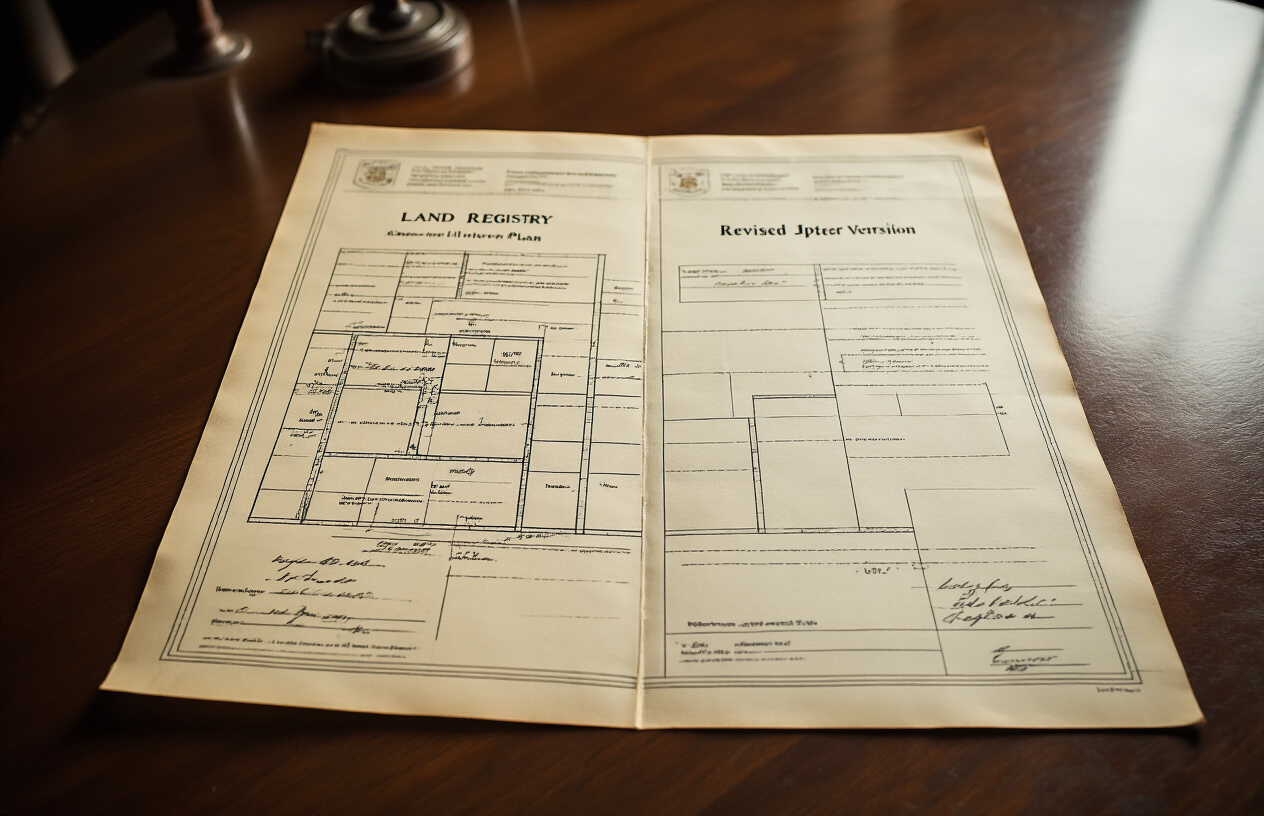
Circumstances that trigger plan updates
HM Land Registry does not routinely update title plans once they’re created. We will only make amendments to title boundaries with the registered proprietor’s agreement or as a result of specific applications. Updates may occur during registration when we need to consider the latest survey information, prompting us to prepare replacement title plans with suitable register notes. We may also revise plans to show later Ordnance Survey mapping information when land has been sold from the title, ensuring accuracy reflects current ownership boundaries.How subdivision of titles works
We can subdivide registered titles either on first registration or subsequently, with each part registered under separate title numbers. Under the Land Registration Rules 2003, we may divide titles on proprietor application, if we consider it desirable for keeping the registered title, or when registering a charge of part. Each subdivided part maintains the same registered proprietors in the same capacity, and we ensure all relevant entries affecting that specific part remain in the new register.When surveys are required and what they involve
We commission Ordnance Survey to conduct surveys for a small percentage of applications when we need to supply new topographic detail, check accuracy of existing mapping against title deed evidence, or gather site information including ground measurements, boundary feature details, and photographs. When surveys are required, we notify all parties involved, who must complete Ordnance Survey’s online form providing property access details and potential site hazards before the surveyor can proceed with their mapping accuracy assessment.Common References and Symbols on Plans

Understanding easements and rights of way markings
When we examine title plans, easements and rights of way are typically shown using colored references, broken lines, or specific symbols that correspond to entries in the register. These markings help us identify areas where neighboring properties have legal rights over our land, or where we have rights over adjoining property. For instance, a passageway at the back of a property might be described verbally in the register rather than shown with a separate plan reference. Drainage rights are commonly displayed using colored broken lines on the title plan.Restrictive covenant indicators
We’ll find restrictive covenants identified through colored tinting or references on title plans, such as blue or pink areas that correspond to specific entries in the charges register. These visual markers help us locate exactly which parts of our property are subject to particular restrictions or promises not to perform certain activities. The register will always explain what these colored references mean, detailing the specific covenants that affect the tinted areas.Ordnance Survey features that appear on plans
Our title plans are prepared using extracts from Ordnance Survey maps, which means we’ll encounter various OS symbols and features that may not directly relate to our registered title. These include OS field numbers, parcel numbers, and standard mapping symbols that appear on the underlying survey map. While these features generally have no special significance for our registration, we should note that if OS markings have been circled in blue with corresponding register entries, they’ve been specifically referenced for easements or covenants affecting our property.Getting Copies and Using Title Plans Effectively

How to obtain official copies and their costs
To access your red line plan Land Registry documents, we start by searching property information to find your title number. Official copies cost £7 to download, while individual deed documents cost £11 each if marked as ‘filed’ in the register and scanned copies are available through HM Land Registry.Reading title plans together with registers
We must examine title plans alongside the property register, as the register provides additional details about rights over adjoining land and ownership history. Since HM Land Registry maintains digital records rather than paper deeds, we rely on these combined documents to understand the complete property picture and any filed documentation.When to seek professional legal advice about boundaries
Given that our Land Register serves as the definitive record of property ownership in England and Wales, we should consult legal professionals when boundary disputes arise or when interpreting complex rights and restrictions. Professional advice becomes essential when original deeds contain additional boundary information not fully captured in the registered title plan. Understanding red line plans and title plans is essential for anyone dealing with property transactions, boundary disputes, or land registration matters. We’ve explored how these documents work as visual representations of your property’s extent, the importance of reading them alongside the property register, and the various color-coding systems that identify easements, covenants, and boundary features. Remember that the red edging shows general boundaries rather than exact legal boundaries, and the scale limitations of Ordnance Survey mapping mean these plans serve as guides rather than precise measurements.
Whether you’re a property owner, solicitor, or conveyancer, we recommend always obtaining official copies from HM Land Registry and consulting the accompanying register for complete understanding. If you encounter boundary disputes or need precise boundary determination, seeking professional legal advice remains the best course of action. By mastering how to read and interpret these crucial documents, you’ll be better equipped to navigate property matters with confidence and avoid potential complications in your land dealings.
Understanding red line plans and title plans is essential for anyone dealing with property transactions, boundary disputes, or land registration matters. We’ve explored how these documents work as visual representations of your property’s extent, the importance of reading them alongside the property register, and the various color-coding systems that identify easements, covenants, and boundary features. Remember that the red edging shows general boundaries rather than exact legal boundaries, and the scale limitations of Ordnance Survey mapping mean these plans serve as guides rather than precise measurements.
Whether you’re a property owner, solicitor, or conveyancer, we recommend always obtaining official copies from HM Land Registry and consulting the accompanying register for complete understanding. If you encounter boundary disputes or need precise boundary determination, seeking professional legal advice remains the best course of action. By mastering how to read and interpret these crucial documents, you’ll be better equipped to navigate property matters with confidence and avoid potential complications in your land dealings.

